 Latviešu
 По-русски
 In English
The commercial property market in the first half of 2026 continues to gradually stabilize, but in the office segment, the balance of power has clearly shifted in favor of tenants. There is so much space available in new, energy-efficient Class A office buildings—and construction continues—that companies looking for premises can choose and even dictate terms. This is according to the latest commercial real estate market review by "Latio" for the first half of 2026.
Overall, the macroeconomic environment in the commercial real estate market is becoming more favorable, showing a gradual recovery—private consumption is renewing, wages are growing, and lending is gradually picking up. At the same time, investment activity remains limited by geopolitical uncertainty and corporate caution, so rapid growth is not expected in the near future. Investors' required yield in the office segment is currently around 7%, while in the industrial and retail segments it is around 8%.
The Tenant Dictates the Terms
In recent years, a significant amount of square footage in new, high-class offices has been commissioned in Riga, whereas the number of large, financially strong tenants looking for spacious prime space in Latvia is relatively small. Additional pressure is created by the consolidation of the hybrid work model, which reduces companies' need for large space areas. As a result, the same tenants often simply move from one building to another—from older premises to newer ones, or from larger spaces to smaller ones. In Riga, tenants can afford to be more demanding. To attract clients, developers are forced to offer more favorable conditions, flexible layouts, and invest more in interior finishing.
"Due to the large supply, the market right now can undoubtedly be called a tenant's market—there are plenty of offers to choose from to find the most suitable one on desired terms," notes Anda Locāne, Commercial Real Estate Manager at "Latio".
As concluded in the "Latio" review, tenants increasingly expect discounts and other "perks" from owners, while those owners who are ready to adapt premises for a specific tenant and make concessions gain loyal clients in the long run. Several solutions operate in the market: large spaces are split into smaller offices (spaces ranging from 50–130 m² find tenants faster than 400–800 m²), the intended use of buildings is changed by registering them under medical or educational facility space codes (which accelerates their leasing), and harder-to-lease space is converted into residential housing.
Several large tenants, when relocating their offices, leave behind premises for which it is difficult to find a new equivalent tenant. In the long term, this is also changing the understanding of how commercial real estate is developed and managed.
"The most successful commercial property owners right now are those who are most open to unprecedented ideas and ready to look for solutions," emphasizes Anda Locāne. As explained in the report, the perception of the office as a workspace has changed, presenting both an opportunity and a challenge. One way to attract new occupants is through international companies—new entrants to Latvia—that choose their Baltic headquarters among the three Baltic countries. Latvia has plenty to offer in terms of both price and quality.
Under these circumstances, the role of an experienced intermediary is growing. "Latio" advises both parties: helping tenants find the most suitable conditions, and assisting owners and developers in attracting tenants to fill new premises.
Significant Price Differences
The new report summarizes current rental and sales prices across all commercial property segments.
Class A office rents in the center reach €22/m² per month, whereas Class C space in less in-demand locations can be rented starting from €5/m²—location and building class can quadruple the price.
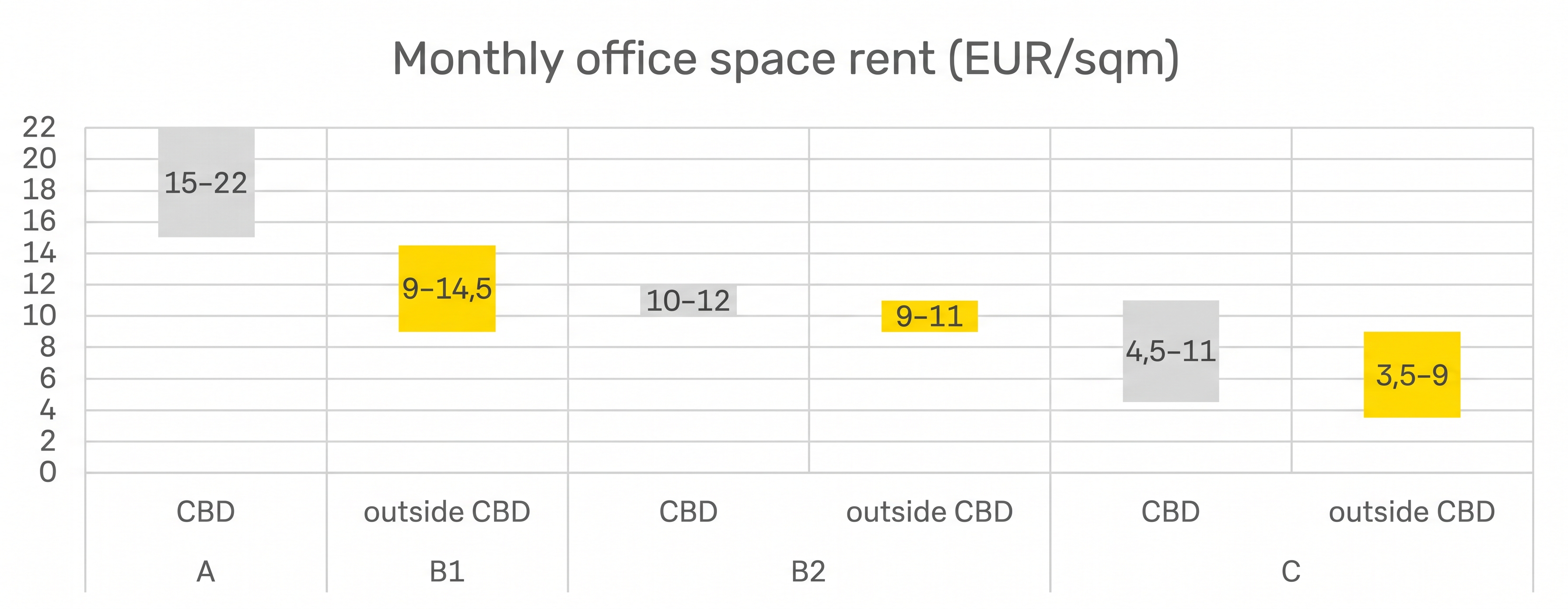
However, low prices may not save landlords in the long run. "Buildings with relatively high maintenance or utility costs will not be able to compete even with low rent rates. Tenants carefully examine all potential charges to prevent unexpected unpleasant expenses in the future," points out Anda Locāne.
Meanwhile, for investors, higher yields are currently promised not by offices, but by industrial and retail space—around 8% annually compared to 7% for offices. Today, the office competes with the warehouse for investor attention.
The latest report covers all segments—from offices and industrial space to real estate properties, hotels, forests, and agricultural land—as well as the largest transactions in each segment and ratings by industry experts.
Additional Information:
Dr. oec. Ksenija Ijevleva
Latio | Market Analyst
E-mail: ksenija.ijevleva@latio.lv
Mob. +371 26814932
www.latio.lv